Shipping & Logistics
Transhipment and Why Your Cargo Changes Ships
Most containers travel on more than one vessel, transferring at hub ports because running large ships between hubs and small ones to spokes costs less than direct services everywhere.

A container moving between two ports often travels on two or three separate vessels. The transfers are not inefficiency but the result of an economic structure built around vessel size.
Large ships are only cheap when full
Cost per container falls substantially with vessel size, but only if the ship sails loaded, since the saving comes from spreading fuel and crew across more boxes.
Few individual port pairs generate enough volume to fill a very large vessel, so direct services between them would sail partly empty and lose the advantage.
Concentrating cargo from many origins onto one large ship between two hubs is what makes the size economics work.
The hub and spoke structure
Smaller feeder vessels collect containers from regional ports and deliver them to a hub, where they are loaded onto a mainline ship for the long ocean leg.
At the far end the process reverses, with feeders distributing boxes to their final ports from the arrival hub.
This allows small ports to be served at all, since they generate volumes far below what a direct mainline call would require.
Hubs are chosen for position and cost
A transhipment hub sits close to a main shipping route, so the deviation for a mainline vessel is short and the time cost of calling is small.
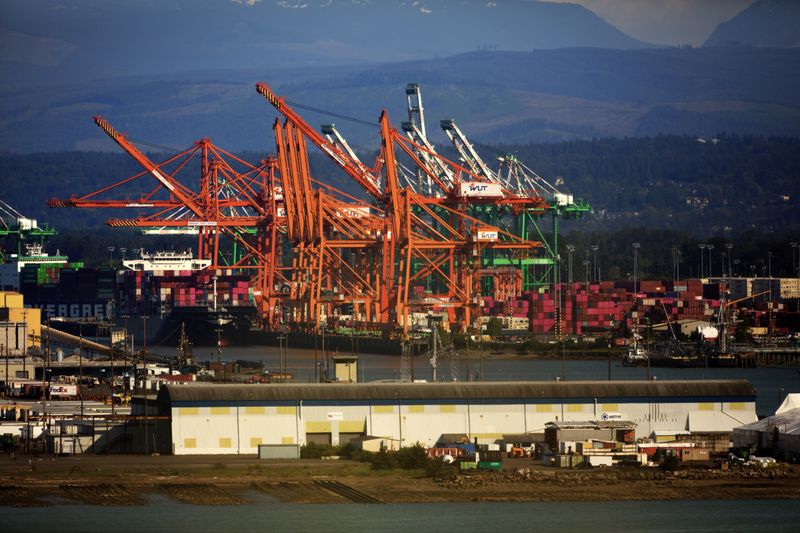
It also needs deep water, substantial crane capacity and the ability to handle a large number of moves quickly, since transhipment doubles the handling per box.
Because transhipment cargo has no local origin or destination, hubs compete directly on cost and reliability, and volumes can move between them relatively quickly.
Each transfer adds risk and time
A container that misses its onward connection waits for the next service, which on some routes means a delay of a week rather than a day.
Additional handling also raises the chance of damage or misrouting, and complicates tracking where systems between carriers are not fully integrated.
Shippers with time-sensitive cargo therefore pay a premium for direct services where they exist, accepting higher freight for fewer transfers.
Customs treatment of goods passing through
Cargo transhipping through a country is generally not treated as an import, since it does not enter the domestic market and is not released for consumption.
Procedures exist to keep such goods under customs control while in the port, which is what allows the transfer without duty liability.
The rules governing transit and transhipment differ between jurisdictions and are periodically revised, particularly where security screening requirements apply.
Questions readers ask
When is air freight justified?
When freight is a small share of product value, when the selling window is short, or when the alternative is a stockout with a larger cost. It is a planning tool as much as an emergency one.
Does rail always beat sea on time?
On continental corridors it is generally faster than an equivalent sea routing. Reliability varies by corridor and season, so the variance should be checked alongside the average.
Also by Rukmini Pathak
- Minimum Efficient Scale, and Why Some Plants Have to Be EnormousManufacturing
- Why Freight Is Priced by Route Rather Than by DistanceShipping & Logistics
- Incoterms: Three Letters That Decide Who Owns the ProblemShipping & Logistics
- Bigger Ships Need Bigger EverythingShipping & Logistics